
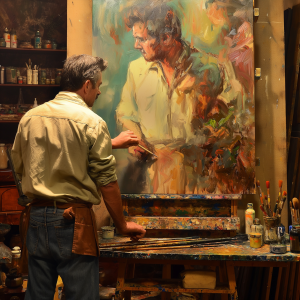
I am stuck on play. I just can't emphasize it enough. And now that I have read about the science behind it, I am obsessed. I am beginning to understand why I love to play in the art studio so much. I am an addict. Literally. After spending yet another week deep diving into the neuroscience of flow and creative aging, I am still not ready to give it up. It is fascinating to me, and important for any of us who are in the "next stage of life", that is over 50 years of age. It is exciting!
The way we learn as kids is we play, right? We're involved in the process. We're not attached to outcome. There's no shame. There's no embarrassment because there's no failure. With deliberate practice, you're only right if you do the exact same thing and build on it with deliberate play. Meaning there's 360 degrees and there's only one degree of right. With deliberate play, there's only one degree of wrong. There's no wrong answer with deliberate play. It's so much more freedom. If you look under the hood at the areas we get stuck like shame, embarrassment, and self-consciousness, they shut down learning. More importantly what we get from play is a curious cocktail of endorphins. Play, from the perspective of curiosity and experimentation, floods you with endorphins. The really nice, feel-good neurochemicals. If you get into flow during play, it is a big win. Flow is the only time you get dopamine, norepinephrine, serotonin, oxytocin, and endorphins all at the same time.
There is way more going on than just that. Neuroscientists seem to know a bunch of neurochemicals that are also involved like glutamate, GABA, acetylcholine, but the big five pleasure chemicals are all included. Flow does appear to be the only time you get all five at once. To put this in context, just to reconcile how pleasurable we're talking about let's compare it to romantic love. We've all fallen in love. It's a very potent high. The romantic love high is dopamine and norepinephrine mixed together (other research suggests oxytocin). Flow is dopamine, norepinephrine, plus three other pleasure chemicals. Dopamine, may be the most potent of all of the pleasure chemicals, it's definitely the most addictive or one of the most addictive anyway. There are about 20 different endorphins in the brain, these are painkillers. Endorphins, also known as endogenous opioids. Interestingly, the term endorphin comes from the words “endogenous,” meaning from the body, and “morphine", an opiate pain reliever. The most common is 100 more times potent than medical morphine, it's the same chemical according to the neurochemists. Endorphins then are internal opiates, like external opiates, morphine, heroin, those sorts of things. And our internal one, the most common one, is 100 times more potent than morphine. Yikes! I literally am addicted to flow. The good news is that the addiction is the only one that leads in a positive direction.
Moving on. A quick question on how learning and memory work in the brain? The more neurochemicals that show up at the front end of experience, the better chance it's going to move from short-term holding into long-term storage. Neurochemicals do many different jobs. One of the things they do is they tag, especially reward chemicals, which is what we're talking about. They tag experiences as important and save them for later.
Another big bonus for studio play is the role it has in overcoming resistance, procrastination, or creative block. Once you get away from outcomes, it's like the resistance just goes away. The typical resistance you feel on every level just diminishes. That's the diminishment of self. That's the medial prefrontal cortex, which is your default load network, it gets really quiet. What happens? The element of risk goes away. Creativity releases, you're no longer doubting all your ideas, you're willing to consider all of them, even the wonky ones.
How does all of this translate to in the real world in a behavioral sense, a psychological sense? One of the most well-established facts in psychology is that flow underpins happiness, well-being, overall life satisfaction, meaning, and purpose. The people who score off the charts for all those things are the people with the most flow in their lives. In fact, the last study Mihaly Csikszentmihalyi did before he died was on flow proneness over time. What he found is the only time flow proneness goes away is if you start losing physical functionality, especially if you were an extreme sports athlete and that is how you typically accessed flow.
While some cognitive abilities decline with age, others flourish in our 50s and beyond. Science has debunked the long slow rot theory. That is what Steven Kotler refers to the theory that we just continue to decline as we age until there is nothing left. That popular belief was held until the 90's when a closer look was taken a Freuds work. Sigmund Freud initially stood on that theory but much of his groundbreaking work was in later years which in itself disavowed that notion. Neuroscientists have found that the brain doesn't atrophy with age. Specific cognitive abilities, like relativistic thinking, systems thinking, empathy, and creativity, become more prominent in later life. That is good news for artists. We can create and produce for a very long time. Play, exercise, and above all, find flow.
References
https://www.researchgate.net/publication/224927532_Flow_The_Psychology_of_Optimal_Experience
Flow: The Psychology of Optimal Experience, January 1990, Publisher: Harper & Row, Mihaly Csikszentmihalyi
The art of seeing: an interpretation of the aesthetic encounter.Mihaly Csikszentmihalyi - 1990 - Los Angeles, Calif.: Getty Center for Education in the Arts. Edited by Rick Emery Robinson.
What is the nature of the aesthetic experience? Is it the same for everyone? It is possible to facilitate its occurrence? This book focuses on the psychology of the aesthetic experience and on the perception and understanding of art, suggesting ways to raise levels of visual literacy and enhance artistic enjoyment. The findings will be of importance not only to museum professionals and art educators, but also to psychologists and those interested in the nature of the aesthetic experience.
https://philpapers.org/s/Mihaly%20Csikszentmihalyi
Note: As Dr. Mihaly Csikszentmihalyi is the father of flow research his body of work is groundbreaking. Steven Kotler has taken his work to the next level and made it accessible to those of us who are not PHD's in psychology or neuroscience. If you want to really get this, Kotler's Flow Research Collective has an amazing, immersive course where they teach it. I am saving my pennies as it is a huge investment.
Steven Kotler books-these are all affiliate links so if you have no interest in supporting us at no extra cost to you, don't use these links.
The Art of Impossible: A Peak Performance Primer
https://amzn.to/3SNyING
The Rise of Superman: Decoding the Science of Ultimate Human Performance
https://amzn.to/3T4pKNu
Stealing Fire: How Silicon Valley, the Navy SEALs, and Maverick Scientists Are Revolutionizing the Way We Live and Work
https://amzn.to/3SFwcJo
Okay, this is getting really long. I am sure you can tell that I may be a touch over enthusiastic about this research. I honestly can't believe I am just now finding it. Below are some videos from my YouTube channel this week.
Digital to traditional wildlife painting/Tradigital
https://youtu.be/BS2pq7OH6w0
Mixed Media Abstract Landscape
https://youtu.be/3LYiZ9kRkZc
Thrift Store Project African Mask Redo/Mixed Media Pt 1
https://youtu.be/gtEhB2L6Jz8
Mixed Media Thrift Store Makeover Pt 2
https://youtu.be/OPeillf5nhM
Have an AMAZING week! Stay frosty,
TO

 Unlocking Flow: The Art of Aging Creatively
